Official Colors
Design Breakdown
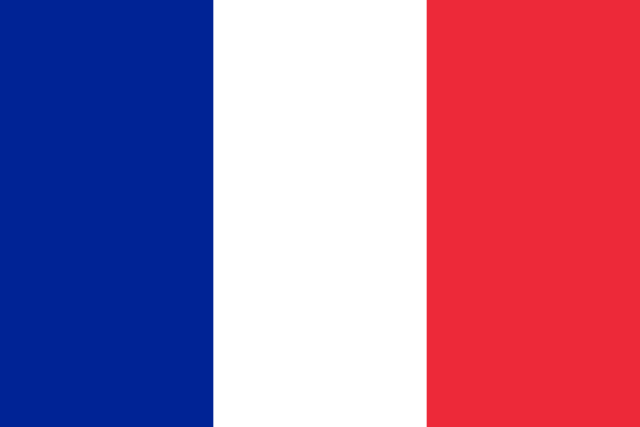
The French Tricolore is composed of three equal vertical bands of blue (hoist), white (center), and red (fly), each occupying exactly one-third of the flag's width. The overall proportion of the flag is 2:3 (height to width), meaning the flag is half again as wide as it is tall.
The three bands are perfectly rectangular with no decorative elements, emblems, or additional markings on the standard national flag. This stark geometric simplicity is intentional — the flag was designed to be bold, legible, and reproducible by any citizen during the Revolution. The civil ensign and military variations exist with slightly adjusted proportions, but the basic triband design remains unchanged across all official versions.
The precise shade of blue used on the modern Tricolore was standardized to #002395 (Pantone 281 C) and the red to #ED2939 (Pantone 485 C). For a period during the 1800s and early 1900s, slightly different shades were in use, making the current standardized colors a relatively recent formalization.
Symbolism & History
The French Tricolore is one of the most influential flags in history, serving as the direct inspiration for the tricolour flags of dozens of nations — including Ireland, Italy, Belgium, and Romania. It emerged from the French Revolution of 1789, when revolutionary cockades of blue and red (the traditional colors of Paris) were combined with the white of the Bourbon royal house. The Marquis de Lafayette is traditionally credited with suggesting the addition of white to create the tricolor cockade.
The three colors have accrued rich symbolic meaning over time. Blue is associated with the patron saint of Paris, Saint Martin, and represents vigilance, truth, loyalty, perseverance, and justice. White historically represented the French monarchy and the purity of the royal Bourbon line, though after the Revolution it was reinterpreted as representing peace and honesty. Red stands for hardiness, valor, and the blood of French patriots.
The Tricolore in its vertical striped form was officially adopted on February 15, 1794, during the period of the First French Republic. It was subsequently discontinued during the Restoration (1814–1830) when the Bourbons returned and restored the white royalist flag, but it was permanently reinstated after the July Revolution of 1830 under King Louis-Philippe. Since then it has remained the flag of France through empires, republics, and occupations.
Today the Tricolore is explicitly associated with the national motto Liberté, Égalité, Fraternité — Liberty, Equality, Fraternity. These three ideals, born from the Revolution, align philosophically (if not officially) with the three colored bands: liberty (blue), equality (white), and fraternity (red). The flag flies from every public building in France and its overseas territories, and is recognized as one of the world's most instantly identifiable national symbols.
Design Your Own Tricolore
Build a vertical triband flag in your own colors — in under 60 seconds with Vexillum.
Open Flag Studio →