Official Colors
Design Breakdown
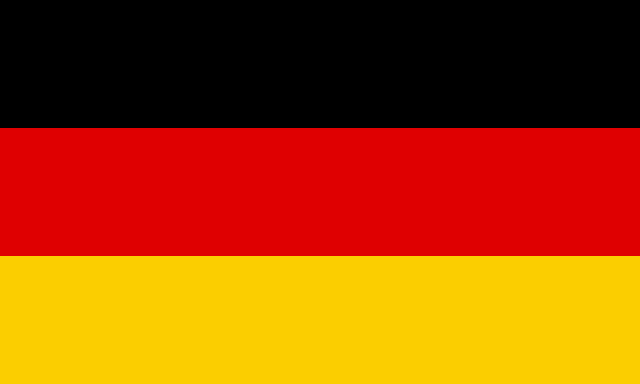
The German federal flag consists of three equal horizontal bands in the order black (top), red (middle), and gold (bottom). The flag's official proportion is 3:5 (height to width), making it slightly wider relative to its height than many other European flags. Each band occupies exactly one-third of the flag's total height.
The standard national flag carries no additional emblems. However, the Bundesdienstflagge (federal service flag), used by federal authorities, bears the Bundesadler — the Federal Eagle, a stylized black eagle with red feet and beak on a gold shield — centered in the middle red band. This emblem version is restricted to official government use. The black, red, and gold combination is also represented in the German coat of arms: a black eagle on a gold field with red detailing.
The precise gold shade is standardized to RAL 1021 (Rapsgelb / Rapeseed Yellow), which corresponds to approximately #FFCE00. The black is pure black and the red is standardized to RAL 3020. These colors must appear in strict sequence from top to bottom — reversing the order would create the Belgian flag rather than the German one.
Symbolism & History
The combination of black, red, and gold has deep roots in German history, dating back at least to the Holy Roman Empire and the black eagle on gold of the Habsburg dynasty. The colors gained their modern political meaning during the early 19th century, when they were adopted by the Lützow Free Corps — a volunteer unit that fought against Napoleon's armies. The corps wore black uniforms with red facings and gold buttons, and their battle flag bore these same colors.
The colors took on explicitly liberal and nationalist political meaning at the Hambach Festival of 1832 and were formally adopted by the Frankfurt Parliament of 1848 as the colors of a unified, democratic Germany. The black-red-gold tricolor was briefly the flag of the failed revolution's German Confederation, making it symbolically linked to democratic ideals and the aspiration for a unified German nation-state.
After German unification under Prussia in 1871, the conservative empire under Bismarck used black, white, and red (Prussia's colors) as the imperial flag — discarding the revolutionary tricolor. The Weimar Republic restored black-red-gold from 1919 to 1933, before the Nazi regime again replaced it. This history explains why the colors carry such strong democratic associations: they were consistently suppressed by authoritarian governments and restored with each return to democracy.
The current flag was officially adopted by West Germany on May 23, 1949, with the founding of the Federal Republic. When Germany reunified in 1990, the tricolor was retained as the flag of the unified nation. Today, black-red-gold is universally recognized as a symbol of German democracy, unity, and the hard-won lessons of 20th-century history.
Build a Bold Horizontal Tricolor
Three equal bands, your colors. Design a flag like Germany's in Vexillum.
Open Flag Studio →